
Understanding the 2026 Shift: How Data Privacy Regulations Affect US Product Testing Programs
The landscape of data privacy is in a constant state of evolution, and for businesses operating in the United States, 2026 is shaping up to be a pivotal year. With new regulations looming and existing ones maturing, the way US product testing programs collect, process, and store consumer data is set for a significant overhaul. Ignoring these changes is not an option; proactive understanding and adaptation are crucial for maintaining compliance, fostering consumer trust, and ensuring the continued success of your product development cycles. This comprehensive guide delves into the anticipated impact of the 2026 data privacy shift on US product testing, offering insights and actionable strategies to navigate the complexities ahead.
The Evolving Data Privacy Landscape: Why 2026 Matters
While federal data privacy legislation in the US has historically lagged behind regions like the European Union (with GDPR), individual states have stepped up to fill the void. The California Consumer Privacy Act (CCPA) and its successor, the California Privacy Rights Act (CPRA), set a precedent, inspiring similar laws in states like Virginia (VCDPA), Colorado (CPA), Utah (UCPA), and Connecticut (CTDPA). By 2026, many of these state-level regulations will be fully enforced, and new ones are likely to emerge. Furthermore, there’s an increasing push for a comprehensive federal privacy law, which, if enacted, would dramatically alter the compliance landscape.
The convergence of these state laws, coupled with the potential for federal intervention, creates a complex web of requirements. For product testing programs, which inherently rely on collecting data from individuals – often personal, behavioral, and demographic information – this means a heightened need for scrutiny over data collection practices, consent mechanisms, data storage, and deletion policies. The stakes are high: non-compliance can lead to hefty fines, reputational damage, and a significant erosion of consumer trust.
Anúncios
Key Data Privacy Principles Impacting Product Testing
Understanding the core principles underpinning these modern data privacy regulations is the first step towards preparedness. While specific details may vary, most regulations share common tenets:
- Lawfulness, Fairness, and Transparency: Data must be processed lawfully, fairly, and in a transparent manner in relation to the data subject. This means clear communication about data collection and usage in product testing scenarios.
- Purpose Limitation: Data should be collected for specified, explicit, and legitimate purposes and not further processed in a manner that is incompatible with those purposes. For product testing, this means data collected for testing a specific feature should not be repurposed for unrelated marketing without explicit consent.
- Data Minimization: Data collected should be adequate, relevant, and limited to what is necessary in relation to the purposes for which they are processed. Product testing programs should only gather data essential for the test objectives.
- Accuracy: Personal data should be accurate and, where necessary, kept up to date.
- Storage Limitation: Personal data should be kept in a form which permits identification of data subjects for no longer than is necessary for the purposes for which the personal data are processed. This impacts how long test data can be retained.
- Integrity and Confidentiality (Security): Personal data should be processed in a manner that ensures appropriate security of the personal data, including protection against unauthorized or unlawful processing and against accidental loss, destruction, or damage, using appropriate technical or organizational measures.
- Accountability: The data controller (the organization running the product test) is responsible for, and must be able to demonstrate compliance with, these principles.
Specific Challenges for US Product Testing Programs
The impending 2026 data privacy changes present several distinct challenges for product testing programs:
Anúncios
1. Enhanced Consent Requirements
Gone are the days of vague terms and conditions. Modern privacy laws demand clear, affirmative, and unambiguous consent. For product testing, this translates to:
- Granular Consent: Users must be able to consent to specific types of data collection (e.g., performance data, biometric data, usage patterns) rather than a blanket agreement.
- Easy Withdrawal of Consent: Participants must have an equally easy way to withdraw their consent at any time, and their data must be subsequently handled according to their wishes.
- Transparent Information: Before consent is given, participants need to be fully informed about what data is being collected, why it’s being collected, how it will be used, who will have access to it, and for how long it will be stored.
2. Data Subject Rights (DSRs)
Consumers are gaining more control over their personal data. Product testing programs must be equipped to handle:
- Right to Access: Participants can request to see what data has been collected about them.
- Right to Rectification: Participants can request corrections to inaccurate data.
- Right to Deletion (Right to Be Forgotten): Participants can request the permanent deletion of their data. This is particularly challenging for long-term product testing or longitudinal studies.
- Right to Portability: Participants can request their data in a portable, machine-readable format.
- Right to Opt-Out of Sale/Sharing: While product testing data isn’t typically ‘sold’ in the traditional sense, sharing data with third-party analytics providers or research partners falls under this scrutiny.
Implementing robust processes to respond to these DSRs within specified timeframes will be critical.
3. Data Minimization and Anonymization
The principle of data minimization dictates that product testing should only collect data absolutely necessary for the test’s objectives. Furthermore, wherever possible, data should be anonymized or pseudonymized. This means:
- Reviewing Data Collection Forms: Eliminate unnecessary fields.
- Aggregating Data: Instead of individual-level data, can you use aggregated statistics?
- Pseudonymization: Replacing direct identifiers with artificial identifiers, allowing for analysis without directly identifying individuals.
- Anonymization: Irreversibly transforming data so that it cannot be linked back to an individual. True anonymization is often complex but highly desirable from a privacy perspective.
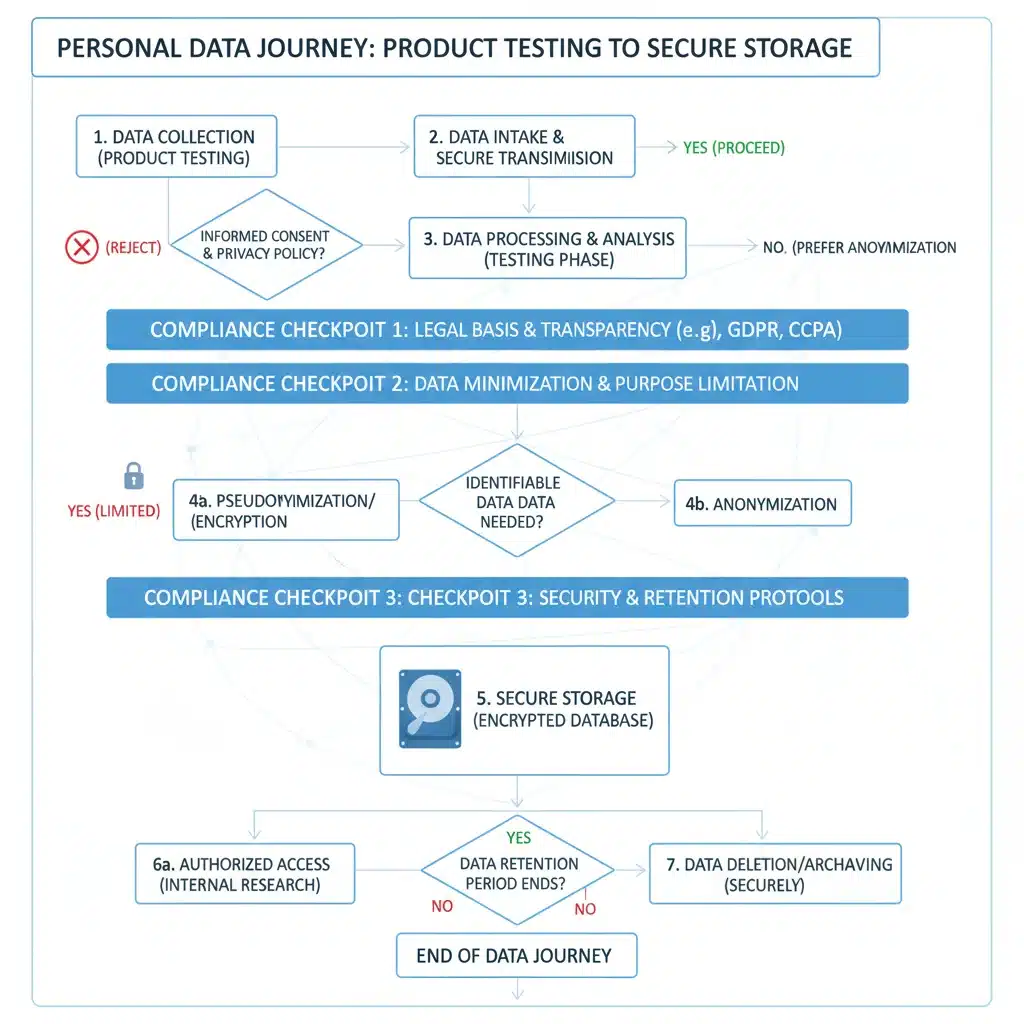
4. Cross-Border Data Transfers
Even for US-based product testing, if data is processed or stored on servers outside the US, or if third-party vendors are located internationally, cross-border data transfer rules might apply. While the US lacks a single federal law, state laws might have provisions, and international frameworks like GDPR (if dealing with EU citizens) remain relevant. Understanding the data flow and the location of all data processors is paramount.
5. Vendor Management and Third-Party Risk
Product testing often involves various vendors: survey platforms, data analytics tools, cloud storage providers, and recruitment agencies. Each of these third parties becomes a potential point of privacy vulnerability. Organizations must:
- Due Diligence: Thoroughly vet all third-party vendors for their privacy and security practices.
- Data Processing Agreements (DPAs): Implement robust contracts that clearly define responsibilities, data handling procedures, and compliance obligations.
- Auditing: Periodically audit vendors to ensure ongoing compliance.
Strategies for Ensuring Compliance and Building Trust
Navigating the 2026 data privacy landscape requires a proactive and holistic approach. Here are key strategies for US product testing programs:
1. Conduct a Comprehensive Data Audit
Before you can comply, you need to know what you’re dealing with. A data audit should:
- Map Data Flows: Identify all points of data collection, storage, processing, and transfer within your product testing ecosystem.
- Categorize Data: Distinguish between personally identifiable information (PII), sensitive personal information (SPI), and non-identifiable data.
- Identify Legal Basis: For every piece of personal data collected, determine the legal basis for processing (e.g., consent, contractual necessity, legitimate interest).
- Assess Current Practices: Evaluate existing consent forms, privacy notices, data retention policies, and security measures against anticipated 2026 standards.
2. Implement Privacy by Design (PbD)
Privacy by Design means embedding privacy considerations into the very core of your product testing programs from the outset, not as an afterthought. This includes:
- Early Privacy Impact Assessments (PIAs): Conduct PIAs for new product tests or significant changes to existing ones to identify and mitigate privacy risks.
- Default Privacy Settings: Design systems where the default setting is the most privacy-protective option.
- Data Minimization by Default: Only collect data that is absolutely essential for the test objectives.
- Security Integration: Build robust security measures into data collection and storage infrastructure from day one.
3. Strengthen Consent Mechanisms
Review and revise all consent forms and privacy notices. Ensure they are:
- Clear and Concise: Easy for participants to understand, avoiding legal jargon.
- Specific: Detail exactly what data is collected and for what specific purposes.
- Freely Given: No coercion or bundling of consent for unrelated purposes.
- Unambiguous: Require an affirmative action from the participant (e.g., ticking a box).
- Accessible: Provide easy mechanisms for participants to review, modify, or withdraw their consent.
4. Develop Robust Data Subject Rights (DSR) Response Procedures
Establish clear, documented processes for handling DSR requests. This includes:
- Designated Contact Point: A clear channel for participants to submit requests.
- Verification Procedures: Methods to verify the identity of the requester to prevent unauthorized access.
- Timelines: Adhering to the response deadlines mandated by relevant regulations (e.g., 30-45 days).
- Data Retrieval and Deletion Protocols: Technical capabilities to efficiently locate, provide, or delete specific user data across all systems involved in product testing.

5. Enhance Data Security
Data breaches are not only costly but also severely erode trust. Strengthen your security posture by:
- Encryption: Encrypting data both in transit and at rest.
- Access Controls: Implementing strict role-based access controls to limit who can access sensitive test data.
- Regular Security Audits: Conducting periodic vulnerability assessments and penetration testing.
- Employee Training: Ensuring all personnel involved in product testing are trained on data privacy best practices and security protocols.
- Incident Response Plan: Having a clear plan in place for responding to data breaches, including notification procedures.
6. Update Data Retention Policies
Review and revise your data retention schedules. Only keep data for as long as it is necessary for the stated purpose of the product test, or as required by law. Implement automated deletion or anonymization processes when data reaches the end of its retention period. This is a critical aspect of compliance with the 2026 data privacy framework.
7. Legal Counsel and Ongoing Monitoring
Given the dynamic nature of data privacy laws, engaging legal counsel specializing in this area is invaluable. They can provide specific guidance tailored to your organization and help interpret complex regulations. Furthermore, establish a system for ongoing monitoring of new privacy legislation and regulatory guidance, both at the state and potential federal levels.
The Benefits of Proactive Privacy Compliance
While the prospect of adapting to new privacy regulations might seem daunting, there are significant benefits to proactive compliance beyond avoiding penalties:
- Enhanced Consumer Trust: Demonstrating a commitment to privacy builds trust, which is invaluable for recruiting participants for future product tests and fostering brand loyalty. Consumers are increasingly privacy-aware and will choose brands that respect their data.
- Competitive Advantage: Organizations that can clearly articulate their robust privacy practices may gain a competitive edge, especially in industries where data sensitivity is high.
- Improved Data Quality: Focusing on data minimization and purpose limitation often leads to collecting higher-quality, more relevant data for product testing.
- Streamlined Operations: Implementing clear data governance policies and DSR procedures can lead to more efficient and organized data management practices overall.
- Future-Proofing: Building a strong privacy foundation now will make it easier to adapt to future regulatory changes, including a potential federal privacy law.
Case Study: A Hypothetical Product Testing Scenario
Consider a tech company developing a new smart home device that collects user interaction data to improve its AI assistant. Under the 2026 data privacy regulations, their product testing program would need to:
- Granular Consent: Clearly ask users if they consent to voice data collection for AI training, separate from general usage data.
- Data Minimization: Only collect snippets of voice data relevant to improving the AI, not entire conversations. Anonymize voice samples where possible.
- DSR Handling: Provide an easy-to-use portal for participants to request access to their voice data or to have it deleted from the training sets.
- Security: Encrypt all voice data during transmission and storage, and restrict access to only essential AI developers.
- Retention: Delete voice data after it has been processed and used for AI model improvement, unless longer retention is explicitly consented to and justified.
Failure to adhere to these principles could result in significant fines and a backlash from privacy-conscious consumers, severely impacting the product’s launch and the company’s reputation.
The Role of Technology in Compliance
Technology plays a crucial role in managing the complexities of 2026 data privacy compliance for product testing. Solutions include:
- Consent Management Platforms (CMPs): Tools that help manage user consent preferences, ensuring they are properly recorded and respected.
- Data Discovery and Classification Tools: Software that helps identify and categorize personal data across various systems.
- Automated DSR Request Fulfillment: Platforms that streamline the process of responding to access, rectification, and deletion requests.
- Data Loss Prevention (DLP) Solutions: Technologies that prevent sensitive data from leaving controlled environments.
- Pseudonymization and Anonymization Tools: Software that assists in transforming identifiable data into privacy-enhanced formats.
Investing in the right technological infrastructure can significantly reduce the manual effort and risk associated with privacy compliance.
Conclusion: Preparing for a Privacy-Centric Future
The 2026 data privacy shift is not merely a legal hurdle; it represents a fundamental change in how businesses must interact with consumer data. For US product testing programs, this means moving beyond basic compliance to truly embedding privacy into the organizational culture and operational processes. By understanding the core principles, addressing specific challenges, and adopting proactive strategies, organizations can not only avoid penalties but also build stronger relationships with their participants and customers. The future of product testing is inextricably linked with robust data privacy practices. Start preparing now to ensure your programs are resilient, trustworthy, and successful in the privacy-centric world of 2026 and beyond.