Mastering Agile Project Management: A Comprehensive Guide for Success

Anúncios
Mastering Agile Project Management: A Comprehensive Guide for Success
In today’s fast-paced business environment, the ability to adapt quickly and deliver value efficiently is paramount. This is where Agile Project Management comes into play. Agile isn’t just a methodology; it’s a mindset, a philosophy that has revolutionized how teams approach complex projects, particularly in software development, but increasingly across various industries. This comprehensive guide will delve deep into the world of Agile, exploring its core principles, popular frameworks, benefits, and how to effectively implement it to achieve unparalleled project success.
What is Agile Project Management?
At its heart, Agile Project Management is an iterative approach to delivering projects throughout their lifecycle. Instead of a linear, sequential process (like the traditional Waterfall method), Agile advocates for continuous collaboration, flexibility, and incremental delivery. The focus is on breaking down large projects into smaller, manageable chunks, known as iterations or sprints, typically lasting 1-4 weeks. Each iteration involves planning, execution, testing, and review, leading to a potentially shippable product increment.
The Agile Manifesto: Guiding Principles
The foundation of Agile lies in the Agile Manifesto, penned in 2001 by seventeen independent software developers. It outlines four core values and twelve supporting principles that guide Agile teams:
Anúncios
Four Core Values:
- Individuals and interactions over processes and tools
- Working software over comprehensive documentation
- Customer collaboration over contract negotiation
- Responding to change over following a plan
These values emphasize people, functionality, collaboration, and adaptability, shifting the focus from rigid plans and extensive documentation to delivering tangible results and being flexible in the face of evolving requirements.
Twelve Supporting Principles:
- Our highest priority is to satisfy the customer through early and continuous delivery of valuable software.
- Welcome changing requirements, even late in development. Agile processes harness change for the customer’s competitive advantage.
- Deliver working software frequently, from a couple of weeks to a couple of months, with a preference to the shorter timescale.
- Business people and developers must work together daily throughout the project.
- Build projects around motivated individuals. Give them the environment and support they need, and trust them to get the job done.
- The most efficient and effective method of conveying information to and within a development team is face-to-face conversation.
- Working software is the primary measure of progress.
- Agile processes promote sustainable development. The sponsors, developers, and users should be able to maintain a constant pace indefinitely.
- Continuous attention to technical excellence and good design enhances agility.
- Simplicity—the art of maximizing the amount of work not done—is essential.
- The best architectures, requirements, and designs emerge from self-organizing teams.
- At regular intervals, the team reflects on how to become more effective, then tunes and adjusts its behavior accordingly.
Why Choose Agile Project Management?
The adoption of Agile Project Management has grown exponentially due to its numerous benefits. For organizations striving for efficiency, customer satisfaction, and a competitive edge, Agile offers a compelling alternative to traditional project management methodologies.
Anúncios
Enhanced Flexibility and Adaptability
One of the primary advantages of Agile is its inherent flexibility. In today’s dynamic markets, requirements can change rapidly. Agile allows teams to embrace these changes, pivot quickly, and adjust priorities without derailing the entire project. This adaptability ensures that the final product remains relevant and valuable to the end-user, a critical factor for success.
Improved Customer Satisfaction
Agile places the customer at the center of the development process. Through continuous feedback loops, regular demonstrations of working increments, and active collaboration, customers are deeply involved. This ensures that the product being built truly meets their needs and expectations, leading to higher satisfaction levels and stronger relationships.
Faster Time to Market
By delivering working software or product increments frequently, Agile enables organizations to release value to the market much faster than traditional methods. This ‘early and continuous delivery’ allows businesses to gain a competitive advantage, gather real-world feedback sooner, and iterate on their product based on actual usage.
Increased Team Collaboration and Morale
Agile fosters a culture of collaboration, transparency, and self-organization within teams. Daily stand-ups, regular reviews, and retrospectives encourage open communication and shared responsibility. This collaborative environment often leads to higher team morale, increased ownership, and a more engaged workforce.
Better Quality and Risk Management
The iterative nature of Agile, combined with continuous testing and feedback, helps in identifying and addressing issues early in the development cycle. This proactive approach to quality assurance significantly reduces the number of defects and improves the overall quality of the product. Furthermore, by breaking down projects into smaller increments, risks are identified and mitigated more effectively, preventing them from escalating into major problems.
Popular Agile Frameworks
While Agile is a broad philosophy, several frameworks implement its principles. The most widely adopted include Scrum, Kanban, and Lean.
Scrum: The Most Popular Agile Framework
Scrum is an iterative, incremental framework for managing complex product development. It is perhaps the most popular and widely used Agile methodology. Scrum defines specific roles, events, and artifacts.
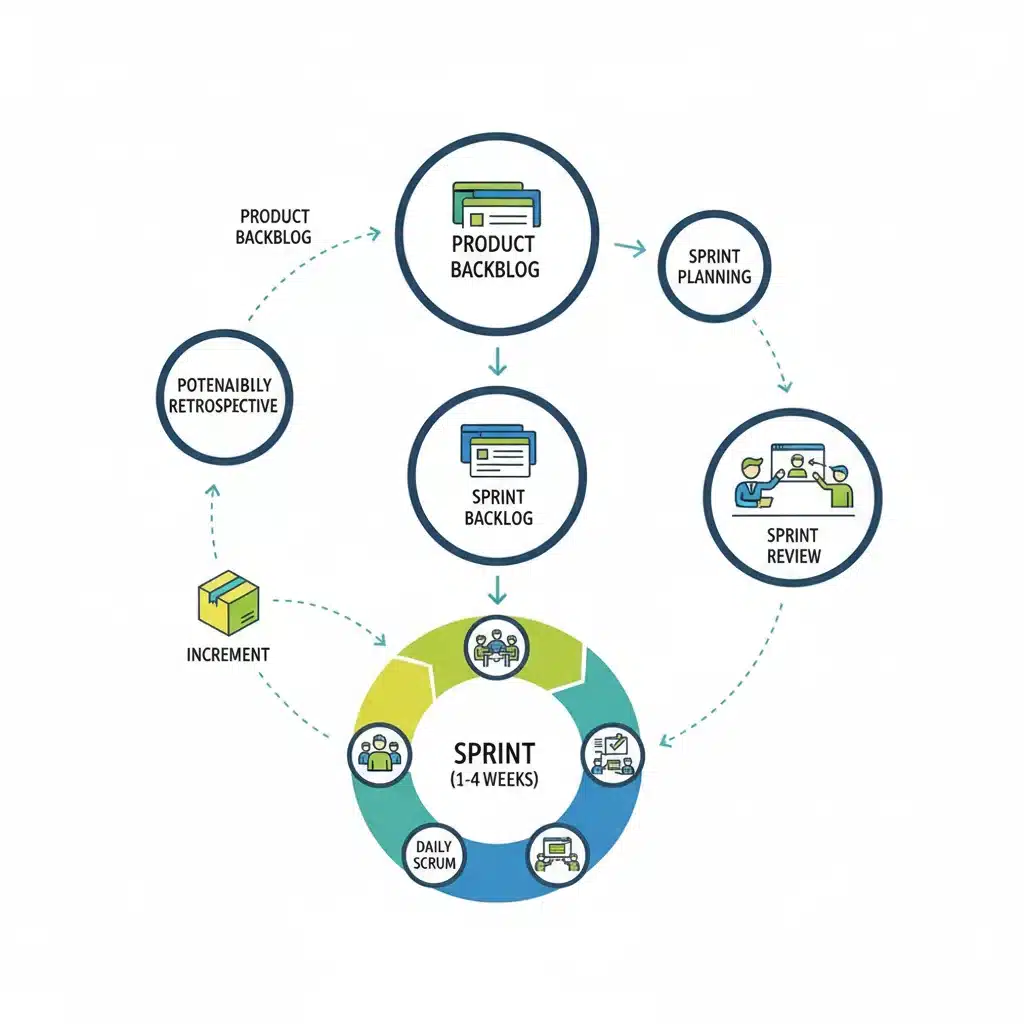
Scrum Roles:
- Product Owner: Responsible for maximizing the value of the product and the work of the Development Team. Manages the Product Backlog.
- Scrum Master: Facilitates the Scrum process, removes impediments, and ensures the team adheres to Scrum values and practices.
- Development Team: A self-organizing, cross-functional team responsible for delivering a potentially shippable product increment at the end of each Sprint.
Scrum Events (Ceremonies):
- Sprint Planning: The team plans the work to be performed in the upcoming Sprint.
- Daily Scrum (Stand-up): A short, daily meeting for the Development Team to synchronize activities and create a plan for the next 24 hours.
- Sprint Review: The team presents the work accomplished during the Sprint to stakeholders and discusses feedback.
- Sprint Retrospective: The team inspects how the last Sprint went regarding individuals, interactions, processes, and tools, and identifies improvements for the next Sprint.
Scrum Artifacts:
- Product Backlog: An ordered list of everything that might be needed in the product.
- Sprint Backlog: The set of Product Backlog items selected for the Sprint, plus a plan for delivering the product increment and realizing the Sprint Goal.
- Increment: The sum of all the Product Backlog items completed during a Sprint and the value of the increments of all previous Sprints.
Kanban: Visualizing Workflow
Kanban is another highly effective Agile framework focused on visualizing work, limiting work in progress (WIP), and maximizing efficiency. Unlike Scrum’s time-boxed sprints, Kanban is a continuous flow system.
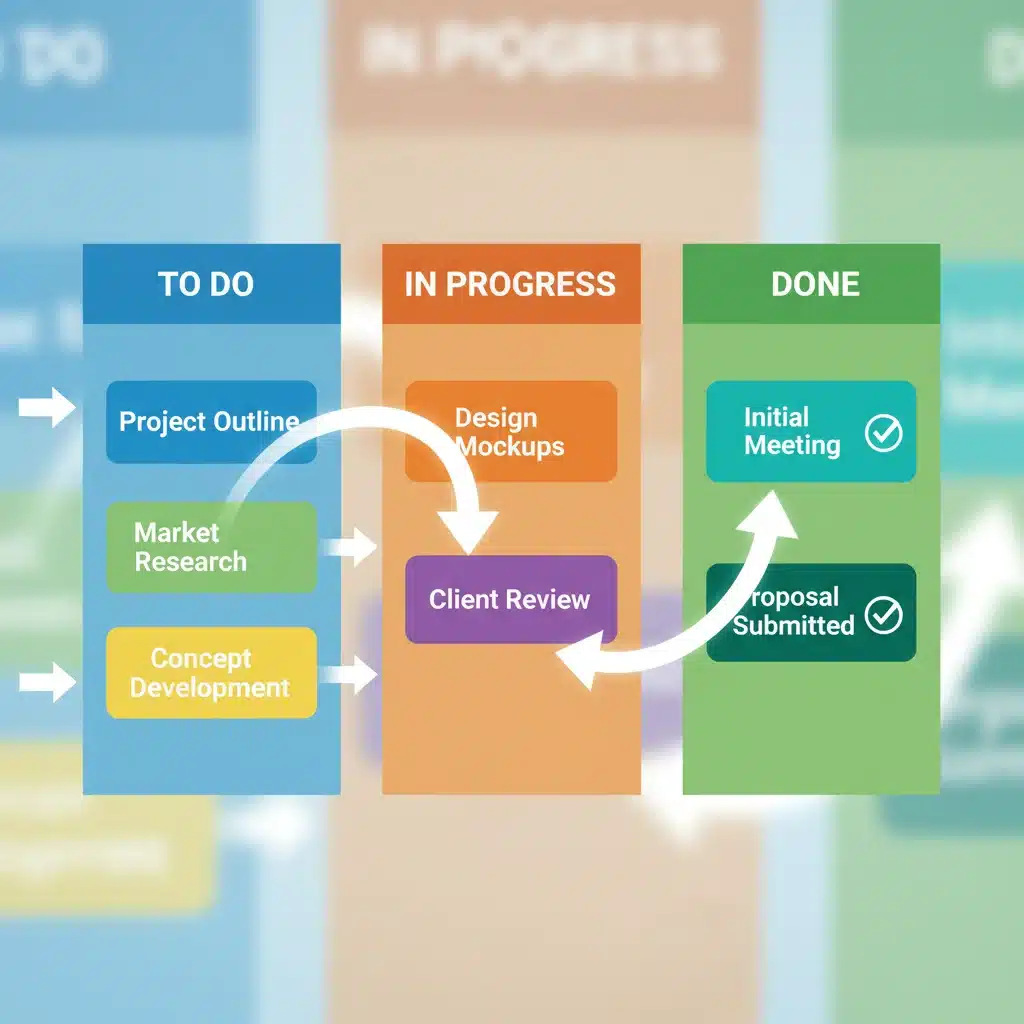
Kanban Principles:
- Visualize the workflow: Use a Kanban board to represent all stages of the work process.
- Limit Work In Progress (WIP): Restrict the number of tasks in each stage to prevent bottlenecks and ensure focus.
- Manage flow: Monitor, measure, and improve the flow of work through the system.
- Make process policies explicit: Clearly define how work is done and how the system operates.
- Implement feedback loops: Regularly review and adjust the process.
- Improve collaboratively, evolve experimentally: Encourage continuous improvement through shared understanding and data-driven decisions.
Kanban is particularly useful for teams with unpredictable work arrivals or those needing a highly flexible approach to task management. It helps in identifying bottlenecks and optimizing the flow of value to the customer.
Lean Software Development: Eliminating Waste
Derived from the Lean manufacturing principles, Lean Software Development focuses on maximizing customer value while minimizing waste. It emphasizes seven core principles:
- Eliminate Waste
- Amplify Learning
- Decide as Late as Possible
- Deliver as Fast as Possible
- Empower the Team
- Build Integrity In
- See the Whole
Lean principles often complement other Agile frameworks, providing a strong foundation for continuous improvement and efficiency.
Implementing Agile Project Management: Best Practices
Adopting Agile Project Management successfully requires more than just understanding the frameworks; it demands a shift in organizational culture and practices. Here are some best practices for effective implementation:
Start Small and Scale Gradually
Don’t try to transform your entire organization overnight. Begin with a single pilot project or a small team to experiment with Agile. Learn from the experience, refine your approach, and then gradually scale Agile practices across more teams and projects.
Foster a Culture of Trust and Transparency
Agile thrives on trust, transparency, and open communication. Encourage team members to speak up, share ideas, and provide honest feedback. Transparency in progress, challenges, and decisions builds confidence and strengthens team cohesion.
Embrace Continuous Improvement
Agile is all about continuous learning and adaptation. Regular retrospectives are crucial for identifying what went well, what didn’t, and how to improve. Foster a mindset where experimentation and learning from failures are encouraged.
Prioritize Ruthlessly
In Agile, the Product Owner plays a vital role in prioritizing the Product Backlog. Clear, well-defined priorities ensure that the team is always working on the most valuable features first, delivering maximum impact with each iteration.
Empower Self-Organizing Teams
Agile teams are most effective when they are self-organizing and cross-functional. Trust your team members to determine the best way to accomplish their work. Provide them with the necessary resources and support, and then step back to let them innovate.
Maintain Regular Communication with Stakeholders
Keep stakeholders informed and engaged throughout the project lifecycle. Regular reviews and demonstrations provide opportunities for feedback and ensure that the product aligns with their evolving needs. This proactive communication minimizes surprises and builds stronger relationships.
Invest in Training and Coaching
For teams new to Agile, comprehensive training and ongoing coaching are essential. This helps team members understand Agile principles, master the chosen framework, and overcome initial challenges. Consider bringing in experienced Agile coaches to guide your transition.
Common Challenges and How to Overcome Them
While the benefits of Agile Project Management are significant, organizations often encounter challenges during implementation. Recognizing these hurdles and having strategies to overcome them is key to success.
Resistance to Change
People are naturally resistant to change. Team members, managers, and stakeholders accustomed to traditional methods might find the shift to Agile unsettling. Solution: Communicate the ‘why’ behind the Agile adoption, highlight the benefits, provide thorough training, and involve key individuals in the transition process to build buy-in.
Lack of Management Support
Without strong support from leadership, Agile initiatives can falter. If management doesn’t understand or champion Agile, it can lead to resource constraints, conflicting priorities, and a lack of organizational commitment. Solution: Educate senior management on Agile principles and benefits, demonstrate early successes, and involve them in key Agile ceremonies like Sprint Reviews.
Difficulty in Estimating and Planning
Traditional fixed-scope, fixed-time, fixed-cost contracts can be challenging to reconcile with Agile’s iterative and adaptive nature. Estimating in Agile is often done using relative sizing (e.g., story points) rather than absolute time, which can be unfamiliar. Solution: Focus on short-term, iterative planning. Use historical data from past sprints to improve future estimations. Emphasize that Agile planning is continuous and adaptive, not a one-time event.
Scaling Agile in Large Organizations
Implementing Agile across multiple teams and large departments can introduce complexity, coordination challenges, and a need for different scaling frameworks (e.g., SAFe, LeSS, Nexus). Solution: Adopt a recognized scaling framework, ensure clear communication channels between teams, establish communities of practice, and focus on alignment across portfolios and programs.
Maintaining Quality and Technical Debt
The pressure to deliver frequently can sometimes lead teams to cut corners on quality, resulting in technical debt. Solution: Integrate quality assurance throughout the development cycle. Emphasize ‘Definition of Done’ that includes testing and code quality. Dedicate time in each sprint for refactoring and addressing technical debt.
Lack of Customer Involvement
Agile thrives on continuous customer feedback. If customers are unavailable or unwilling to participate actively, the benefits of Agile are diminished. Solution: Educate customers on their role in Agile. Make it easy for them to provide feedback. Schedule regular, convenient opportunities for collaboration and demonstrations.
Tools for Agile Project Management
While Agile emphasizes individuals and interactions over tools, various software solutions can significantly support Agile teams in visualizing work, tracking progress, and facilitating collaboration. These tools are essential for effective Agile Project Management.
- Jira: A powerful and widely used tool for issue tracking and Agile project management, offering extensive features for Scrum, Kanban, and custom workflows.
- Trello: A simple, visual, and flexible Kanban-style tool perfect for small to medium-sized teams or personal project management.
- Asana: A versatile work management platform that supports various project management methodologies, including Agile, with features for task tracking, team collaboration, and workflow automation.
- Azure DevOps: A comprehensive suite of development tools from Microsoft that includes Agile planning tools, version control, build automation, and testing features.
- Monday.com: A highly customizable work operating system that allows teams to build specific workflows for Agile, marketing, sales, and more.
- VersionOne (now CollabNet VersionOne): An enterprise-grade Agile management platform that supports scaling Agile across large organizations with features for portfolio management, release planning, and team-level execution.
- Rally (now Broadcom Rally): Another enterprise-level Agile management solution designed for large-scale Agile transformations, offering robust features for planning, tracking, and reporting.
Choosing the right tool depends on your team’s size, complexity, and specific requirements. It’s crucial to select a tool that complements your chosen Agile framework and enhances team productivity without becoming a burden.
The Future of Agile Project Management
The principles of Agile Project Management are continually evolving and expanding beyond traditional software development. We are seeing increased adoption in marketing, human resources, product development, and even strategic planning. Key trends include:
- Hybrid Approaches: Combining Agile with elements of traditional project management (e.g., ‘Agile Waterfall’ or ‘Wagile’) to suit specific organizational contexts.
- Value Stream Management: A holistic approach that focuses on optimizing the end-to-end flow of value to the customer, from idea to delivery, often leveraging Agile principles.
- AI and Automation in Agile: Using artificial intelligence and automation to enhance Agile processes, such as intelligent backlog prioritization, automated testing, and predictive analytics for sprint planning.
- Focus on Psychological Safety: A growing recognition that a psychologically safe environment is crucial for high-performing Agile teams, encouraging experimentation and open communication.
- Agile for Remote and Distributed Teams: The pandemic accelerated the need for effective Agile practices in remote settings, leading to innovations in virtual collaboration tools and techniques.
As businesses continue to navigate complex and uncertain environments, the adaptability and customer-centric nature of Agile will remain invaluable. Organizations that master Agile will be better positioned to innovate, respond to market changes, and consistently deliver value.
Conclusion
Agile Project Management is more than just a buzzword; it’s a proven approach that empowers teams to deliver high-quality products and services efficiently, adapt to change, and foster a culture of continuous improvement. By embracing its core values and principles, and by leveraging frameworks like Scrum and Kanban, organizations can transform their project delivery capabilities and achieve sustainable success.
The journey to becoming truly Agile is ongoing, requiring commitment, continuous learning, and a willingness to inspect and adapt. However, the rewards—including enhanced customer satisfaction, faster time to market, and more engaged teams—make it a worthwhile endeavor for any organization striving for excellence in today’s dynamic world. Start your Agile transformation today and unlock your team’s full potential.