Mastering Program Terms: 7 Critical Clauses in 2026 Product Testing Agreements

Anúncios
In the rapidly evolving landscape of product development, bringing a new innovation to market requires meticulous planning, rigorous testing, and, crucially, robust legal frameworks. As we look towards 2026, the complexities of product testing agreements are only set to increase, driven by advancements in technology, global collaboration, and stricter regulatory environments. For both innovators seeking to test their groundbreaking products and professional testers offering their services, a deep understanding of the underlying program terms is not just beneficial—it’s absolutely essential. This comprehensive guide will illuminate the seven most critical clauses you must scrutinize in any product testing agreement, ensuring your interests are protected and your ventures are set up for success.
Product testing is the crucible where innovation meets reality. It’s where theoretical concepts are subjected to real-world conditions, uncovering flaws, validating hypotheses, and refining user experience. However, this vital stage is fraught with potential legal pitfalls if the foundational agreement isn’t watertight. From intellectual property disputes to liability concerns, a poorly drafted or misunderstood product testing agreement can derail even the most promising projects. Therefore, understanding the nuances of each clause is paramount for anyone involved in this critical process.
Anúncios
The Evolving Landscape of Product Testing Agreements in 2026
Before diving into specific clauses, it’s important to acknowledge the context of 2026. The tech industry is witnessing an explosion of AI-driven products, IoT devices, and highly specialized hardware and software. This means testing often involves sophisticated data handling, complex algorithms, and interconnected systems. Consequently, traditional legal templates might not adequately address the unique challenges these innovations present. Agreements must be forward-thinking, anticipating potential issues related to data privacy, cybersecurity, and the ethical implications of advanced technologies. This makes the review of every program term more critical than ever.
Why a Robust Product Testing Agreement is Non-Negotiable
A well-structured product testing agreement serves multiple purposes:
Anúncios
- Risk Mitigation: It clearly defines responsibilities, reducing the likelihood of disputes.
- Intellectual Property Protection: It safeguards the innovator’s creations and ensures proper use by the tester.
- Clarity of Expectations: It outlines the scope of work, deliverables, and timelines, fostering transparency.
- Compliance: It helps ensure adherence to industry standards, data protection laws (like GDPR or CCPA, potentially updated versions in 2026), and other regulatory requirements.
- Liability Limitation: It sets boundaries for accountability in case of damages or unforeseen issues.
Without such an agreement, both parties operate in a legal gray area, inviting misunderstandings and potential litigation. Let’s explore the seven critical clauses that form the backbone of any effective product testing agreement for 2026 and beyond.
1. Scope of Work and Deliverables: Defining the ‘What’ and ‘How’
The first and arguably most fundamental clause in any product testing agreement is the Scope of Work. This section meticulously details what product is being tested, the specific tests to be conducted, the methodologies employed, and the expected outcomes. It’s not enough to simply state ‘test the new widget.’ Instead, it should specify:
- Product Identification: Precise description of the product, including versions, components, and any associated software or hardware.
- Testing Objectives: What are the primary goals of the testing? Is it performance validation, bug identification, user experience assessment, or regulatory compliance?
- Test Plan: A detailed outline of the tests, including test cases, environments, tools, and duration.
- Deliverables: What will the tester provide upon completion? This could include detailed test reports, bug logs, performance metrics, user feedback summaries, or recommendations for improvement.
- Timeline and Milestones: Clear start and end dates, along with any interim milestones or reporting deadlines.
Why it’s Critical: Ambiguity here leads to scope creep, unmet expectations, and disputes over payment. Both parties must have a crystal-clear understanding of the ‘what’ and ‘how’ of the testing process. This program term sets the stage for the entire engagement.
2. Intellectual Property (IP) Rights: Guarding Innovation
In product testing, intellectual property is often the most valuable asset at stake. Innovators are entrusting their creations, often proprietary and confidential, to testers. This clause must unequivocally define ownership of existing IP and any new IP generated during the testing process.
- Existing IP: Clearly state that all pre-existing intellectual property associated with the product remains the sole property of the innovator.
- New IP: Address ownership of any improvements, modifications, discoveries, or inventions made by the tester during the testing. Typically, these should be assigned to the innovator, or at least licensed exclusively.
- License to Use: Grant the tester a limited, non-exclusive, non-transferable license to use the product solely for the purpose of conducting the specified tests.
- No Reverse Engineering: Explicitly prohibit the tester from reverse engineering, disassembling, or attempting to derive the source code or underlying technology of the product.
Why it’s Critical: Without robust IP protection, an innovator risks losing control over their creation or inadvertently granting rights they didn’t intend to. For testers, it ensures they are not unfairly claiming ownership over the innovator’s work. This clause is a cornerstone of trust in any product testing agreement.

Consider the potential ramifications in 2026 with highly advanced AI algorithms or proprietary hardware designs. The value of IP is immense, and its protection must be absolute.
3. Confidentiality and Non-Disclosure (NDA): Sealing Sensitive Information
Product testing inherently involves sharing sensitive, proprietary, and often confidential information. A robust Confidentiality and Non-Disclosure Agreement (NDA) clause is therefore indispensable. This section should:
- Define Confidential Information: Broadly define what constitutes confidential information, including product designs, prototypes, test results, marketing plans, trade secrets, and business strategies.
- Obligations of the Receiving Party: Stipulate that the tester (receiving party) must keep all confidential information strictly secret, use it only for the purpose of testing, and not disclose it to any third parties without prior written consent.
- Exceptions: Outline limited exceptions where disclosure might be permitted (e.g., legally compelled disclosure, information already in the public domain, or independently developed information).
- Return/Destruction of Information: Require the return or destruction of all confidential materials upon termination or expiration of the agreement.
- Duration: Specify how long the confidentiality obligations will remain in effect, often extending beyond the agreement’s term.
Why it’s Critical: This clause protects trade secrets and competitive advantages. In an era where data breaches are common, a strong NDA within the product testing agreement is crucial for maintaining trust and preventing irreparable harm to a company’s market position.
4. Indemnification and Limitation of Liability: Allocating Risk
These two clauses work hand-in-hand to define how risks and potential damages are allocated between the parties. They are crucial for protecting both the innovator and the tester from unforeseen circumstances.
- Indemnification: This clause obligates one party (the indemnitor) to compensate the other party (the indemnitee) for losses or damages incurred due to specific actions or omissions. For example, the tester might indemnify the innovator against claims arising from the tester’s negligence or breach of the agreement. Conversely, the innovator might indemnify the tester against claims arising from defects in the product itself.
- Limitation of Liability: This clause sets a cap on the amount of damages one party can claim from the other. It often excludes certain types of damages (e.g., indirect, consequential, punitive damages) and may limit monetary liability to the fees paid under the agreement or a specified amount.
Why it’s Critical: Without these provisions, a minor issue could escalate into a financially devastating lawsuit. They provide a framework for managing risk and ensuring that both parties understand their potential exposure. Navigating these program terms carefully can save significant headaches down the line.
5. Data Privacy and Security: Protecting User and Product Data
With increasing global data protection regulations and the proliferation of data-collecting products, this clause is becoming increasingly complex and vital, especially for 2026 and beyond. It needs to address:
- Data Handling: How will any data collected during testing (especially personal data or sensitive product performance data) be stored, processed, and used?
- Compliance: Explicitly state adherence to relevant data protection laws (e.g., GDPR, CCPA, or future equivalents) and industry-specific regulations.
- Security Measures: Require the tester to implement appropriate technical and organizational security measures to protect data from unauthorized access, loss, or disclosure.
- Data Breach Protocol: Outline procedures for notifying the innovator in the event of a data breach and the responsibilities for remediation.
- Anonymization/Pseudonymization: If personal data is involved, specify requirements for anonymization or pseudonymization where possible.
Why it’s Critical: Non-compliance with data privacy laws can result in hefty fines and severe reputational damage. This clause ensures that both parties are aligned on responsible data stewardship, a growing concern in modern product development.
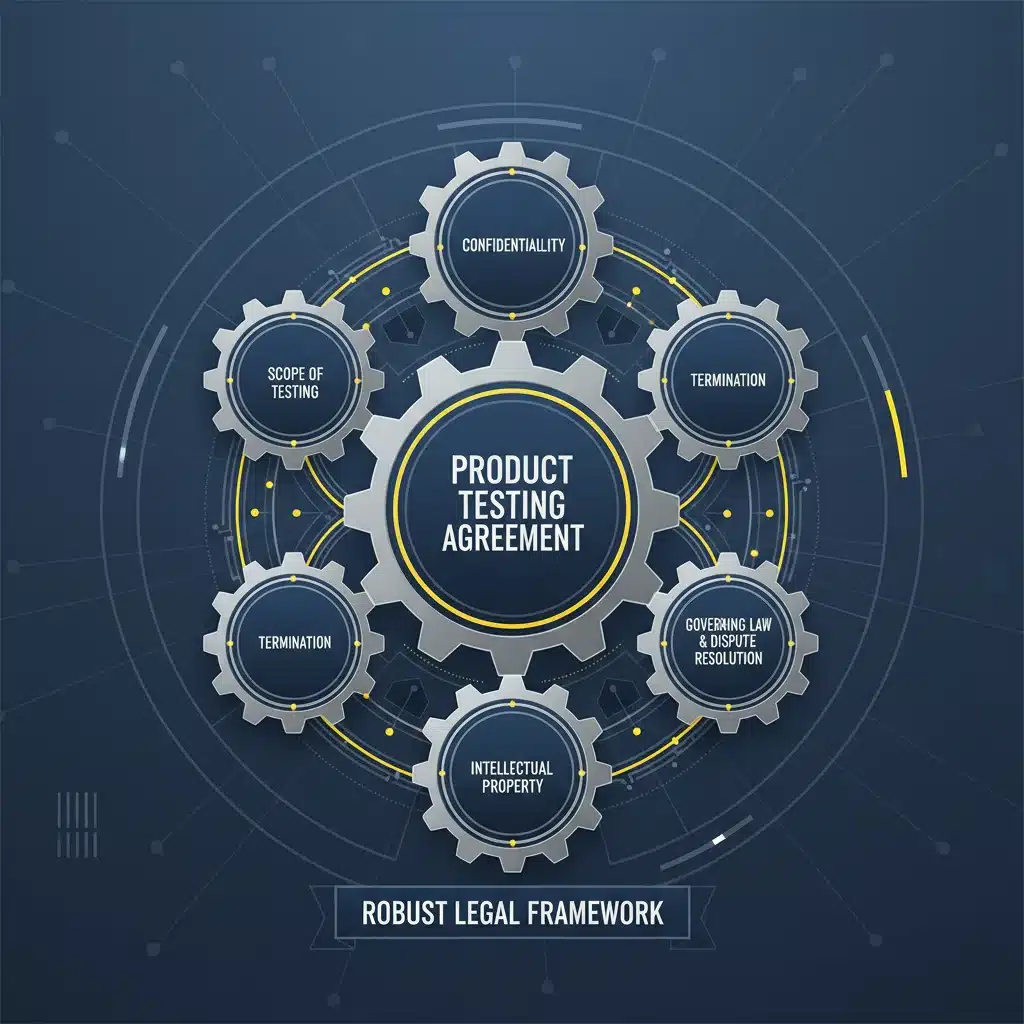
The interconnectedness of these clauses, as visually represented by the gears, highlights the holistic approach needed for a robust product testing agreement.
6. Termination and Survival: Planning for the End
Even the most successful collaborations eventually come to an end. This clause outlines the conditions under which the product testing agreement can be terminated and what obligations survive termination.
- Term: Define the initial duration of the agreement.
- Termination for Cause: Specify reasons for immediate termination, such as breach of contract, insolvency, or failure to meet performance standards.
- Termination for Convenience: Allow either party to terminate the agreement without cause, usually with a specified notice period.
- Effects of Termination: Detail what happens upon termination, including payment for services rendered, return of confidential information, and cessation of testing activities.
- Survival: Identify which clauses (e.g., IP, confidentiality, indemnification, limitation of liability) will continue to be binding even after the agreement has ended.
Why it’s Critical: A clear termination clause prevents ambiguity and potential disputes when the relationship concludes. It ensures an orderly winding down of activities and continues protection for sensitive information and IP. This is a vital program term for long-term legal security.
7. Governing Law and Dispute Resolution: Where and How Disputes are Settled
Disputes, while undesirable, can occur. This clause pre-determines the legal framework that will govern the agreement and the process for resolving any disagreements.
- Governing Law: Specify the jurisdiction whose laws will apply to the interpretation and enforcement of the agreement (e.g., ‘the laws of the State of California, without regard to its conflict of laws principles’).
- Dispute Resolution: Outline the preferred method for resolving disputes. This often follows a tiered approach:
- Negotiation: Initial attempt to resolve disputes directly between the parties.
- Mediation: If negotiation fails, engage a neutral third party to facilitate a settlement.
- Arbitration: A more formal process where a neutral arbitrator (or panel) hears both sides and renders a binding decision, often faster and less expensive than litigation.
- Litigation: As a last resort, disputes are taken to court.
- Forum Selection: If litigation is chosen, specify the court where any legal action will be brought.
Why it’s Critical: This clause provides certainty and predictability in the event of a dispute, avoiding costly and time-consuming jurisdictional battles. It sets the ground rules for how disagreements will be handled, making it a cornerstone of any international or complex product testing agreement.
Beyond the Clauses: Best Practices for 2026 Product Testing Agreements
While understanding these seven critical clauses is essential, their effectiveness is amplified by adhering to broader best practices:
- Legal Review: Always have a qualified legal professional review any product testing agreement before signing, especially for high-stakes projects or those involving novel technologies.
- Clarity and Specificity: Avoid vague language. Every term, condition, and obligation should be explicitly stated to prevent misinterpretation.
- Mutual Understanding: Both parties should fully understand all terms before signing. Don’t hesitate to ask questions or seek clarification.
- Regular Review: For ongoing partnerships, periodically review and update the agreement to reflect changes in project scope, technology, or legal requirements.
- Documentation: Maintain thorough records of all communications, deliverables, and modifications related to the testing process.
The landscape of product development is dynamic, with innovations emerging at an unprecedented pace. The legal frameworks supporting this development must be equally robust and adaptable. By meticulously addressing these seven critical clauses—Scope of Work, Intellectual Property, Confidentiality, Indemnification and Limitation of Liability, Data Privacy, Termination, and Governing Law/Dispute Resolution—both innovators and testers can forge secure, productive partnerships. A well-crafted product testing agreement is not just a legal formality; it’s a strategic asset that safeguards your interests, mitigates risks, and paves the way for successful product launches in 2026 and beyond. Embrace these program terms with diligence, and you’ll build a foundation for innovation that stands the test of time.