Mastering Qualitative Data: 5 Expert Techniques for Actionable Feedback in 2026

Anúncios
Mastering Qualitative Data: 5 Expert Techniques for Actionable Feedback in 2026
In the rapidly evolving landscape of business and technology, the ability to understand human behavior, motivations, and perceptions is more critical than ever. While quantitative data provides the ‘what,’ it is the mastery of qualitative data techniques that truly uncovers the ‘why’ and ‘how.’ As we navigate towards 2026, organizations that effectively harness qualitative insights will gain an unparalleled competitive edge, transforming raw feedback into strategic, actionable decisions. This comprehensive guide delves into five expert techniques for gathering, analyzing, and leveraging qualitative data to provide truly actionable feedback, ensuring your strategies are not just data-driven, but human-centered.
The sheer volume of information available today can be overwhelming. Companies are awash in metrics, analytics, and performance indicators. However, without the nuanced understanding that qualitative research provides, these numbers can often lead to superficial conclusions or, worse, misinformed decisions. Qualitative data offers depth, context, and a rich narrative that quantitative figures alone cannot convey. It’s the voice behind the numbers, the story behind the statistics. Understanding customer sentiment, employee morale, or user experience requires a direct engagement with the human element. This article will equip you with the knowledge and methodologies to excel in this crucial domain, making your feedback mechanisms more robust and your strategic outcomes more impactful.
We’ll explore methodologies that go beyond simple surveys, diving into immersive and insightful approaches. From the art of empathetic interviewing to the power of observational studies, each technique offers a unique lens through which to view your audience. Furthermore, we’ll discuss how to synthesize these diverse data points into coherent narratives and actionable recommendations, bridging the gap between raw information and strategic implementation. Prepare to elevate your understanding of qualitative data and its transformative potential.
Anúncios
The Indispensable Role of Qualitative Data in Modern Business
Before we dive into the specific qualitative data techniques, it’s essential to cement our understanding of why this type of data is not merely beneficial but absolutely indispensable in the current business climate. The digital transformation, coupled with increasingly personalized customer expectations, means that understanding the subjective experiences of individuals is paramount. Companies that fail to connect with their users on a deeper, qualitative level risk developing products, services, and strategies that miss the mark, leading to decreased customer loyalty, poor market fit, and ultimately, reduced profitability.
Anúncios
Consider a scenario where a company sees a drop in app engagement. Quantitative data might show a decrease in daily active users or session duration. While this identifies a problem, it doesn’t explain why users are disengaging. Is the interface confusing? Are there missing features? Is a competitor offering a better experience? These ‘why’ questions can only be answered through qualitative investigation. By applying effective qualitative data techniques, businesses can uncover the root causes of issues, identify unmet needs, and discover unexpected opportunities for innovation.
Moreover, qualitative data is crucial for fostering innovation. Many groundbreaking ideas don’t emerge from analyzing spreadsheets but from observing user struggles, listening to their frustrations, and understanding their aspirations. Think of the early days of personal computing; the desire for a more intuitive graphical interface wasn’t a quantitative metric, but a qualitative insight derived from observing how people struggled with command-line interfaces. This human-centric approach is the bedrock of design thinking and agile development, both of which rely heavily on continuous qualitative feedback loops.
In 2026, with AI and automation becoming even more pervasive, the human touch in product development, marketing, and customer service will become a key differentiator. Understanding the emotional resonance of your brand, the nuanced challenges your customers face, and the subtle cues that drive their decisions will be what sets leading organizations apart. Therefore, investing in robust qualitative data techniques is not just good practice; it’s a strategic imperative for sustained growth and relevance.
Technique 1: Empathetic User Interviews – Digging Deeper for Genuine Insights
One of the most foundational and powerful qualitative data techniques is the empathetic user interview. This isn’t just a Q&A session; it’s a carefully structured conversation designed to uncover deep-seated motivations, pain points, and desires that might not be articulated in a survey. The key word here is ’empathetic.’ Interviewers must approach the conversation with genuine curiosity, active listening, and a non-judgmental attitude, creating a safe space for participants to share their true experiences.
Best Practices for Empathetic Interviews:
- Open-Ended Questions: Avoid yes/no questions. Instead, ask ‘how,’ ‘what,’ and ‘why’ to encourage detailed responses. For example, instead of ‘Do you like our new feature?’, ask ‘Can you describe your experience using the new feature?’ or ‘What challenges did you encounter when trying to achieve [task]?’
- Active Listening and Probing: Pay close attention not just to what is said, but also to how it’s said. Use follow-up questions like ‘Can you tell me more about that?’ or ‘What did that feel like?’ to delve into the nuances of their experience.
- Silence is Golden: Don’t be afraid of pauses. Sometimes, giving the interviewee space to think can lead to more profound insights.
- Non-Verbal Cues: Observe body language, facial expressions, and tone of voice. These non-verbal signals can provide additional context and reveal underlying emotions.
- Avoid Leading Questions: Frame questions neutrally to prevent biasing the participant’s response. For instance, instead of ‘Don’t you agree the new interface is much better?’, ask ‘What are your thoughts on the new interface?’
- Contextual Understanding: Try to understand the user’s environment and the context in which they interact with your product or service. This can often be more revealing than direct questions about the product itself.
The goal of empathetic interviewing is to move beyond surface-level opinions and uncover the underlying needs and mental models of your users. These insights are invaluable for product development, service design, and even marketing messaging. By understanding the ‘why’ behind user actions, you can build solutions that truly resonate and solve real problems.
Once interviews are conducted, the data needs to be meticulously transcribed and analyzed. Look for recurring themes, surprising statements, and emotional responses. Affinity mapping, where individual insights are grouped into common themes, is a powerful technique for synthesizing this rich data into actionable feedback. This method helps to identify patterns and priorities, transforming individual stories into collective insights that can drive strategic decisions.
Technique 2: Observational Studies & Ethnography – Understanding Behavior in Context
While interviews provide self-reported data, observational studies and ethnographic research offer a different, equally powerful perspective by allowing researchers to witness behavior firsthand in its natural environment. This bypasses the potential for recall bias or social desirability bias that can sometimes affect interview responses. As a critical qualitative data technique, observation allows you to see how users truly interact with products, services, or environments, rather than just hearing about it.
Types of Observational Studies:
- Direct Observation: Researchers directly watch and record user behavior. This can be overt (users know they are being observed) or covert (users are unaware). Ethical considerations are paramount, especially with covert observation.
- Participatory Observation (Ethnography): The researcher becomes part of the group or community being studied, immersing themselves in the culture and activities to gain a deep, insider understanding. This is particularly useful for understanding complex social dynamics or cultural nuances.
- Contextual Inquiry: A semi-structured interview technique conducted in the user’s natural environment (e.g., their home or workplace) while they are performing tasks. It combines observation with interview elements, allowing for clarification and deeper understanding of observed behaviors.
- Shadowing: Following a user through their daily routine or a specific task, observing their actions, interactions, and decision-making processes.
The strength of observational studies lies in their ability to reveal unspoken needs, workarounds, and environmental influences that users might not even consciously recognize or articulate. For example, observing how employees struggle with an internal software system might reveal usability issues far more effectively than asking them directly. They might have developed habits to cope that they don’t even perceive as problems anymore until an objective observer points them out.
Ethnography, in particular, requires significant time and commitment but yields exceptionally rich and holistic insights. By living and breathing the user’s world, researchers can uncover deep cultural values, social norms, and unspoken rules that profoundly influence behavior. This can be invaluable for developing products or services for new markets or for understanding complex user journeys.

Technique 3: Focus Groups – Exploring Group Dynamics and Collective Perceptions
Focus groups are a classic qualitative data technique that brings together a small, diverse group of individuals to discuss a specific topic or product under the guidance of a trained moderator. While interviews offer individual depth, focus groups excel at revealing group dynamics, shared perceptions, and the emergence of collective ideas. They are particularly useful for exploring initial reactions, brainstorming, or understanding how different perspectives interact.
Maximizing Focus Group Effectiveness:
- Careful Recruitment: Ensure participants represent your target audience segments. Diversity in demographics and perspectives can enrich discussions, but too much divergence can dilute the focus.
- Skilled Moderation: A good moderator is crucial. They need to facilitate discussion, ensure everyone participates, keep the group on topic, manage dominant personalities, and probe for deeper insights without leading the discussion.
- Structured Discussion Guide: While allowing for organic conversation, a well-prepared discussion guide ensures all key areas are covered. It should include open-ended questions and activities to stimulate engagement.
- Observing Group Interaction: Pay attention to how participants influence each other, how opinions shift, and what consensus or disagreements emerge. These interactions are a rich source of qualitative data.
- Varied Activities: Beyond just talking, incorporate activities like card sorting, mood boards, or prototype testing to elicit different types of feedback and keep participants engaged.
Focus groups are excellent for exploring broad themes, testing initial concepts, or understanding the emotional appeal of a brand. For instance, a company launching a new product might use focus groups to gauge initial reactions to packaging, branding, or key features. The collective brainstorming and debate can often generate ideas that individual interviews might miss.
However, focus groups also have limitations. They can be susceptible to groupthink, where individuals conform to the opinions of more dominant members. The artificial setting might also influence responses. Therefore, it’s often best to use focus groups in conjunction with other qualitative data techniques, such as individual interviews or observational studies, to get a more rounded view.
Technique 4: Content Analysis & Discourse Analysis – Unpacking Textual and Visual Data
In an age dominated by digital communication, a significant portion of qualitative data exists in textual and visual formats. Content analysis and discourse analysis are powerful qualitative data techniques for systematically examining these forms of communication to identify patterns, themes, and meanings. This can include anything from customer reviews, social media posts, support tickets, forum discussions, open-ended survey responses, marketing materials, or even internal company documents.
Content Analysis:
Content analysis involves systematically categorizing and interpreting the content of qualitative data. It can be quantitative in its approach (counting the frequency of certain words or themes) but is inherently qualitative in its interpretation of meaning. The process typically involves:
- Defining Categories: Establishing clear, predefined categories or themes relevant to your research question.
- Coding Data: Systematically going through the text (or images/videos) and assigning codes to segments that fit the predefined categories.
- Analyzing Patterns: Identifying frequencies, relationships, and patterns within the coded data.
For example, a company might perform content analysis on customer support transcripts to identify recurring issues, common frustrations, or frequently requested features. This provides actionable feedback for improving products or services.
Discourse Analysis:
Discourse analysis goes a step further than content analysis. It examines not just what is said, but how it’s said, and the underlying social, cultural, and power dynamics that shape communication. It looks at language in use, exploring how meaning is constructed, how identities are formed, and how arguments are structured. This qualitative data technique is particularly useful for understanding brand perception, public opinion, or internal organizational culture.
For instance, analyzing social media discourse around a new product launch could reveal not just positive or negative sentiment, but also underlying anxieties, cultural interpretations, or even political implications that influence public reception. This provides a much deeper, more nuanced understanding than a simple sentiment analysis tool might offer.
Both content and discourse analysis require careful attention to detail and a strong theoretical framework. They are excellent for extracting insights from large volumes of unstructured text data, making them increasingly relevant for businesses operating in the digital sphere.
Technique 5: Thematic Analysis – Uncovering Patterns and Meanings in Qualitative Data
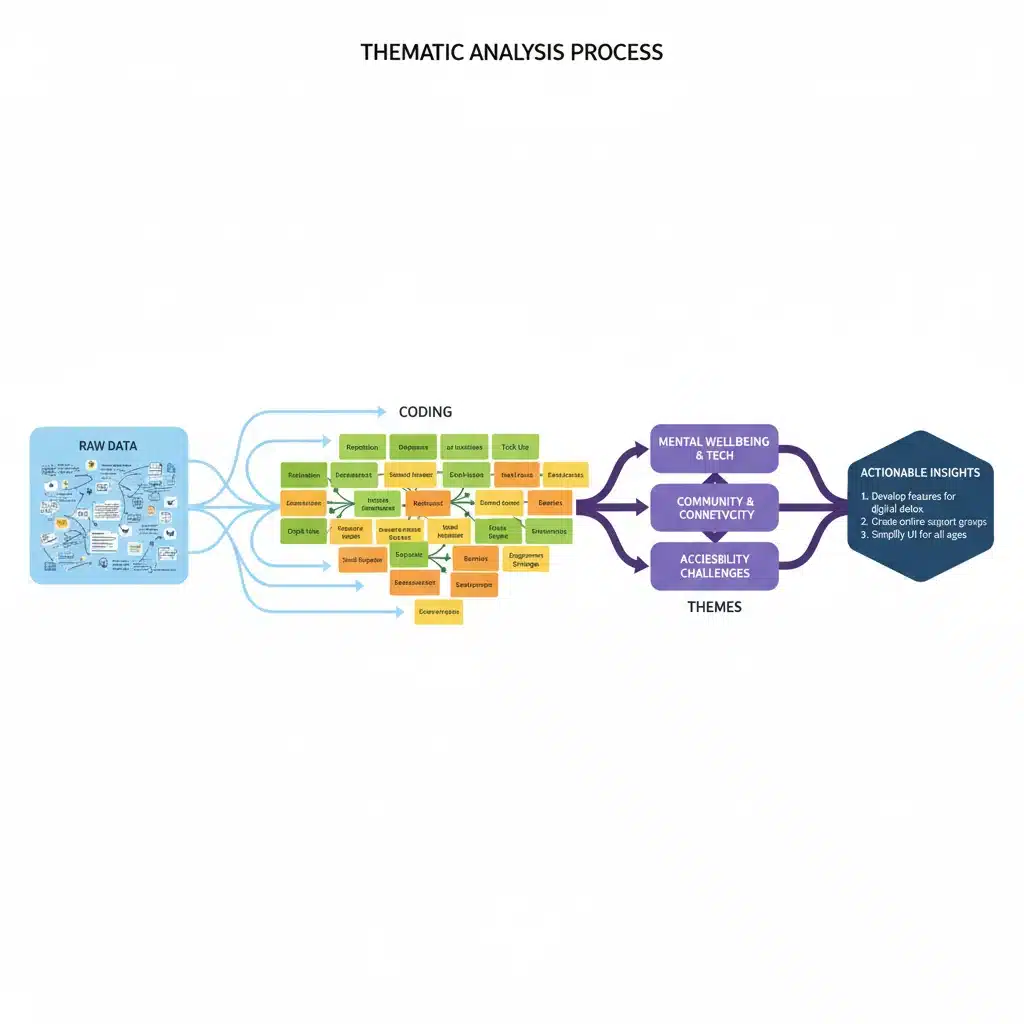
Thematic analysis is arguably one of the most widely used and flexible qualitative data techniques for analyzing textual data. It involves identifying, analyzing, and reporting patterns (themes) within data. It moves beyond simply describing what was said to interpreting the underlying meaning and significance of those patterns. It’s a method that can be applied to data collected from interviews, focus groups, open-ended survey questions, and even observational notes.
The Six Phases of Thematic Analysis (Braun & Clarke Model):
- Familiarizing Yourself with the Data: Immersion in the data through reading and re-reading, listening to recordings, and making initial notes. This helps you get a sense of the depth and breadth of the content.
- Generating Initial Codes: Systematically identifying interesting features across the entire dataset and coding them. A code is the most basic segment of data that can be assessed in a meaningful way regarding the phenomenon.
- Searching for Themes: Collating codes into potential themes. This involves grouping related codes together to form broader, overarching ideas.
- Reviewing Themes: Refining and distinguishing between themes. This phase involves checking if the themes accurately represent the codes and the entire dataset, and if they are distinct from each other. Are there sub-themes? Do some themes need to be merged or broken down?
- Defining and Naming Themes: Developing a detailed analysis of each theme, identifying its essence, and determining what aspect of the data it captures. This also involves selecting clear and concise names for the themes.
- Producing the Report: Weaving together the analytical narrative and extracts from the data to illustrate the themes. This is where you tell the story of your data, explaining how your themes answer your research question and providing compelling evidence from your raw data.
Thematic analysis is powerful because it allows researchers to move from specific data points to broader, conceptual understandings. For example, if conducting interviews about a new software product, individual codes might include ‘difficulty finding feature X,’ ‘frustration with loading times,’ or ‘desire for a dark mode.’ Through thematic analysis, these codes might coalesce into a theme like ‘Usability Challenges’ or ‘Performance Expectations,’ providing a high-level, actionable insight.
This technique is particularly valuable for synthesizing large qualitative datasets into a coherent and understandable structure, making it easier to communicate complex insights to stakeholders. When applied diligently, thematic analysis transforms raw, disparate pieces of information into clear, actionable feedback that can directly inform strategic decisions.
Integrating Qualitative Data for Actionable Feedback in 2026
The true power of these qualitative data techniques emerges when they are not used in isolation but integrated into a holistic research strategy. Combining different methods allows for triangulation, where insights from one method can validate or enrich findings from another, leading to more robust and reliable conclusions. For instance, initial insights from focus groups might inform the questions for in-depth interviews, which then might be validated through observational studies.
From Insights to Action:
- Synthesize Across Methods: After gathering data using various techniques, bring all findings together. Look for common threads, discrepancies, and emergent patterns across different data sources.
- Prioritize Findings: Not all insights are equally important. Use frameworks like impact vs. effort to prioritize which pieces of feedback are most actionable and will yield the greatest return on investment.
- Frame as Recommendations: Translate qualitative insights into clear, concise, and actionable recommendations. Instead of just stating ‘Users are frustrated with the checkout process,’ offer ‘Simplify the checkout process by reducing the number of steps and providing clear progress indicators.’
- Communicate Effectively: Present your findings in a compelling narrative, using quotes, anecdotes, and visual aids to illustrate your points. Make the human element of your data palpable to stakeholders.
- Iterate and Test: Qualitative research is often iterative. Implement changes based on your feedback, then conduct further qualitative (and quantitative) research to test the effectiveness of those changes. This continuous loop of feedback and improvement is key to agile development and customer-centric strategies.
In 2026, the demand for personalized experiences and rapid innovation will only intensify. Organizations that can quickly and accurately understand the nuanced needs and desires of their audience will be the ones that thrive. By mastering these qualitative data techniques, businesses can move beyond simply reacting to market trends and instead proactively shape their future by deeply understanding the human beings they serve.
The ethical considerations surrounding qualitative data collection also cannot be overstated. Ensuring participant privacy, informed consent, and data anonymization are not just legal requirements but fundamental principles that build trust and ensure the integrity of your research. As data collection methods become more sophisticated, so too must our commitment to ethical practices.
Furthermore, technology will continue to play a supporting role. While the core of qualitative research remains human interaction and interpretation, AI-powered transcription services, qualitative data analysis software (e.g., NVivo, ATLAS.ti), and sentiment analysis tools can assist in managing and organizing vast amounts of qualitative data, making the analysis process more efficient. However, it’s crucial to remember that these tools are aids; the critical interpretation and insight generation still firmly rest with human researchers who understand the context and nuances of human experience.
Conclusion: The Future is Qualitatively Informed
The journey to providing truly actionable feedback in 2026 and beyond is paved with a deep understanding of qualitative data. By embracing and mastering these five expert qualitative data techniques – empathetic user interviews, observational studies & ethnography, focus groups, content & discourse analysis, and thematic analysis – organizations can unlock a treasure trove of insights that quantitative data alone cannot provide. These methods empower businesses to connect with their users on a human level, uncover underlying motivations, identify unmet needs, and ultimately, build products, services, and strategies that truly resonate.
In a world increasingly driven by algorithms and automation, the ability to interpret the human story behind the data will be a definitive competitive advantage. Investing in these techniques is an investment in empathy, innovation, and sustainable growth. As you refine your research methodologies, remember that the goal is not just to collect data, but to transform it into wisdom that guides impactful decision-making. The future belongs to those who listen, understand, and act upon the rich narratives found within qualitative data. Start integrating these powerful techniques today and position your organization for unparalleled success in the years to come.