Insider’s Guide to Spotting Legitimate Opportunities: 6 Red Flags to Avoid in 2026 Product Testing Scams
In an increasingly digital world, the allure of earning extra income from the comfort of your home is stronger than ever. One popular avenue that often catches the eye is product testing. Imagine getting paid to try out new gadgets, beauty products, or even food items before they hit the market! Sounds like a dream, right? Unfortunately, where there’s a dream, there’s often a scam lurking in the shadows. As we look towards 2026, the sophistication of online fraud, particularly in the realm of product testing scams, continues to evolve. This comprehensive guide is designed to equip you with the knowledge and tools to differentiate genuine opportunities from elaborate schemes, ensuring your time and personal information remain safe.
The landscape of online work is vast, offering both incredible flexibility and significant risks. Product testing, when legitimate, offers a unique opportunity to influence product development and earn compensation. However, the promise of easy money can often blind individuals to the tell-tale signs of a scam. Our focus today is to dissect the common tactics employed by fraudsters and to empower you with a robust understanding of how to identify, avoid, and report product testing scams. By the end of this article, you’ll be an expert in discerning genuine opportunities from the deceptive traps set by scammers.
Anúncios
The Rise of Product Testing Scams: Why They’re So Prevalent
The internet has democratized many industries, including market research and product development. Companies are constantly seeking feedback from real consumers to refine their offerings. This demand fuels a legitimate industry of product testing. However, the low barrier to entry for setting up an online presence also makes it fertile ground for scammers. They exploit the desire for flexible income and the excitement of receiving free products. The anonymity of the internet allows them to operate with relative impunity, making it crucial for individuals to be extra vigilant.
Furthermore, the economic uncertainties faced by many have led to an increased search for alternative income streams. Scammers are adept at preying on vulnerability, crafting elaborate narratives that sound plausible to those unfamiliar with the legitimate processes of product testing. They leverage sophisticated phishing techniques, convincing websites, and even social engineering to extract money or personal data. Understanding the underlying motivations behind these product testing scams is the first step in protecting yourself.
Anúncios
The sheer volume of online communications also contributes to the problem. With countless emails, social media ads, and pop-ups promising lucrative product testing gigs, it’s easy to get overwhelmed. Discerning truth from fiction becomes a critical skill. Our aim is to provide clarity amidst this digital noise, offering practical advice that cuts through the deception and highlights what truly constitutes a legitimate product testing opportunity.
Red Flag 1: Upfront Fees or Purchases Required
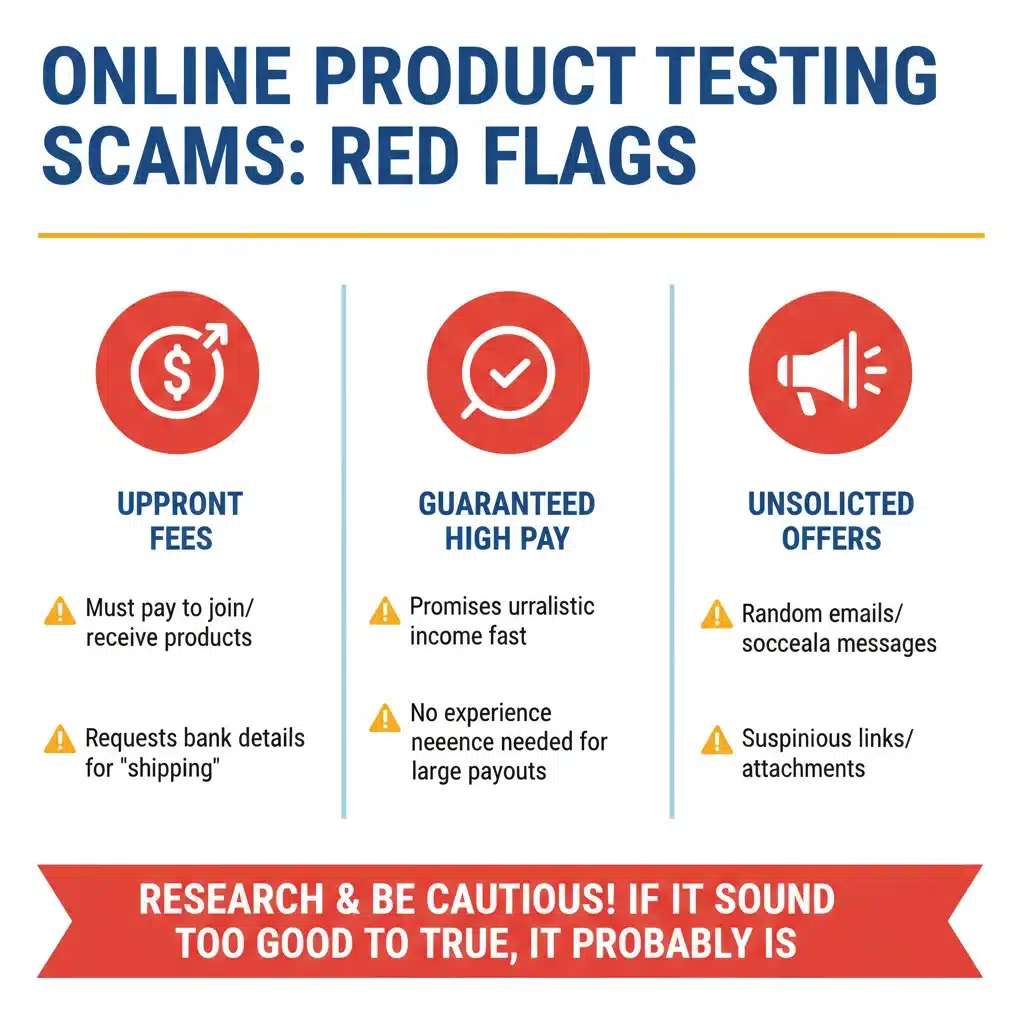
This is arguably the most significant and immediate red flag for any product testing opportunity. Legitimate product testing companies will NEVER ask you to pay a fee to join their panel, access testing products, or receive your payment. Their business model involves paying you for your valuable feedback, not charging you for the privilege. If a company demands an ‘administration fee,’ ‘shipping fee,’ ‘membership fee,’ or insists you purchase a product to ‘qualify’ for testing, walk away immediately. This is a classic tactic used in product testing scams.
Think about it logically: why would a company that needs your feedback on a product make you pay for it? Their goal is to gather data, and they are willing to compensate you for your time and effort. Any request for money upfront is a clear indication that the offer is fraudulent. This extends beyond direct fees; be wary of requests to buy gift cards, transfer money, or use specific payment processors that seem unusual. These are often mechanisms to ensure the money is untraceable once it leaves your hands.
Even if the fee is small, it’s a scam. Scammers often start with a low amount, hoping to hook you in before escalating their demands. Remember, legitimate product testing is about companies paying you, not the other way around. Always prioritize your financial security and never succumb to requests for payment in exchange for a ‘guaranteed’ product testing position.
Red Flag 2: Guaranteed High Pay for Minimal Effort
While product testing can be a fun and rewarding way to earn extra cash, it’s rarely a path to getting rich quick. Be extremely skeptical of offers that promise exorbitant amounts of money for little to no effort. Phrases like ‘Earn $500 a day for testing one product!’ or ‘Guaranteed thousands of dollars monthly!’ are almost always indicative of product testing scams. Legitimate product testing compensation varies widely depending on the product, the complexity of the feedback required, and the time commitment. It’s usually a modest supplemental income, not a primary source.
Real product testing opportunities offer fair compensation for your time and insights. This might range from gift cards, free products, or a reasonable hourly rate, but it’s seldom an amount that sounds too good to be true. Scammers use the promise of high, effortless pay to lure unsuspecting individuals, knowing that the prospect of quick wealth can override common sense.
Always research the typical compensation rates for product testing in your region or for similar products. If an offer significantly deviates from these norms on the higher side, it’s a major red flag. Legitimate companies are transparent about their payment structures and manage expectations realistically. Any offer that sounds like a lottery win for minimal work is likely a product testing scam designed to exploit your aspirations.
Red Flag 3: Unsolicited Offers and Generic Communications
Have you ever received an email or social media message out of the blue, inviting you to become a product tester for a well-known brand? While some companies do recruit through various channels, unsolicited offers, especially those with generic greetings (‘Dear Valued Consumer’) or poor grammar and spelling, are strong indicators of product testing scams. Legitimate companies typically have a more formal recruitment process, often requiring you to sign up on their official website or through reputable market research firms.
Scammers often cast a wide net, sending out mass communications hoping to ensnare a few victims. These emails or messages might impersonate famous brands or create entirely fictitious companies. Always check the sender’s email address – if it’s from a generic domain (e.g., Gmail, Outlook) or a slightly misspelled version of a known company’s domain, it’s likely a scam. Hover over links before clicking to see the actual URL; don’t be fooled by display text.
Furthermore, legitimate companies will personalize their communications to some extent, especially if you’ve previously shown interest in their services. A lack of personalization, combined with an unexpected offer, should trigger your scam alert. Be cautious of any communication that pressures you to act quickly or provides vague details about the ‘opportunity.’ These are classic hallmarks of product testing scams designed to rush you into making a mistake.
Red Flag 4: Requests for Sensitive Personal and Financial Information
While legitimate product testing companies will need some personal information for demographics, shipping, and payment processing, they should never ask for highly sensitive details like your bank account login credentials, your Social Security Number (unless for tax purposes after a significant amount of earnings and through a secure portal), or your full credit card number (beyond what’s necessary for a one-time, legitimate payment if you were, for example, making an approved purchase that would be reimbursed). Be extremely cautious if an offer asks for more information than seems reasonable for the task at hand.
Scammers often use product testing as a guise to commit identity theft or financial fraud. They might create fake ‘onboarding’ forms that mimic legitimate ones, designed solely to harvest your data. They might also ask you to ‘verify’ your identity by providing copies of your driver’s license or passport via insecure channels. Legitimate companies have secure processes for handling sensitive data, usually through encrypted platforms or direct mail for highly sensitive documents.
Before sharing any personal or financial information, verify the legitimacy of the company through independent research. If you’re unsure, err on the side of caution and do not provide the information. Your personal data is incredibly valuable, and protecting it from product testing scams is paramount. Always question why certain information is being requested and whether it aligns with the nature of product testing.
Red Flag 5: Poorly Designed Websites and Unprofessional Communication
In 2026, even small businesses understand the importance of a professional online presence. Legitimate product testing companies, especially those working with established brands, will have well-designed, functional websites that are easy to navigate and free of glaring errors. Conversely, many product testing scams are characterized by shoddy websites with poor grammar, spelling mistakes, broken links, and a generally unprofessional appearance. These sites are often hastily put together and lack the polish of a genuine business.
Beyond the website, pay attention to the quality of communication. While everyone makes mistakes, a consistent pattern of grammatical errors, awkward phrasing, or informal language in official communications (emails, terms and conditions) should raise a red flag. Legitimate companies strive for clear, professional communication. Scammers, often operating from different linguistic backgrounds or simply not caring about professionalism, will frequently overlook these details.
Also, check for a physical address and contact information on their website. While not all legitimate companies will list a full physical address, they should at least provide a working customer service email or phone number. A complete lack of transparent contact information is a significant warning sign that you might be dealing with product testing scams. Always cross-reference any contact details with independent sources to confirm their authenticity.
Red Flag 6: Requests to Process Money or Overpayments
This is a particularly insidious type of product testing scam, often referred to as an ‘overpayment scam’ or ‘reshipping scam.’ The scammer sends you a check (which will eventually bounce) for an amount greater than your agreed-upon payment. They then instruct you to deposit the check, keep your ‘payment,’ and wire the remaining ‘overpayment’ to a third party (often claiming it’s for shipping, taxes, or another tester). By the time your bank realizes the check is fraudulent, you’ve already wired your own money, which is almost impossible to recover.
Another variation involves asking you to receive products and then reship them to another address. This might seem harmless, but you could unwittingly be participating in a money laundering scheme or aiding in the distribution of stolen goods. Legitimate product testing involves you receiving a product, testing it, and providing feedback – it does not involve you acting as a financial intermediary or a shipping agent for unknown parties.
Any instruction that involves you handling money that isn’t directly your payment for services rendered, or asking you to reship products, should be treated with extreme suspicion. These are classic red flags of product testing scams designed to exploit your bank account or involve you in illegal activities. Always ensure that any payment you receive clears your bank before you consider spending or transferring any funds, and never agree to reship items for a company you don’t fully trust.
How to Find Legitimate Product Testing Opportunities
Now that you’re armed with the knowledge to spot product testing scams, let’s talk about how to find the real deal. Legitimate product testing opportunities do exist and can be a rewarding experience. The key is to know where to look and what to look for.
1. Reputable Market Research Companies
Many legitimate product testing opportunities are managed by established market research firms that act as intermediaries between brands and consumers. These companies specialize in recruiting testers and collecting data. Look for well-known names in the industry. A quick online search for ‘reputable market research companies for product testing’ can yield a list of reliable options. Always check reviews and their Better Business Bureau rating.
2. Direct from Brands
Some major brands run their own product testing programs. Often, you can find information about these programs directly on their official websites, usually under sections like ‘Careers,’ ‘Community,’ ‘Join Our Panel,’ or ‘Product Testing.’ Be sure you are on the brand’s official website (check the URL carefully) to avoid landing on a phishing site designed to mimic the brand.
3. Specialized Product Testing Platforms
There are also platforms specifically dedicated to connecting product testers with companies. These platforms vet the opportunities and provide a secure environment for communication and payment. Examples include UserTesting, Pinecone Research, and Influenster, among others. While these platforms can be a great resource, always do your due diligence on the platform itself before signing up.
4. Word of Mouth and Online Communities
Sometimes, the best recommendations come from other people. Online forums, social media groups dedicated to side hustles, or consumer communities can be great places to find legitimate leads. However, exercise caution and verify any recommendations independently, as even in these communities, scammers can sometimes infiltrate.

Protecting Yourself: Best Practices Beyond Spotting Red Flags
Beyond recognizing the specific red flags of product testing scams, adopting a proactive approach to online safety is crucial. Here are some best practices to safeguard your information and finances:
- Do Your Research: Before engaging with any product testing offer, conduct thorough research. Search for the company name followed by ‘scam,’ ‘reviews,’ or ‘complaints.’ Check independent review sites, consumer protection agencies, and social media for any negative feedback.
- Trust Your Gut: If something feels off, it probably is. Don’t let the excitement of a potential opportunity override your instincts. If an offer seems too good to be true, it almost certainly is.
- Use Strong, Unique Passwords: For any legitimate platforms you join, use strong, unique passwords and enable two-factor authentication (2FA) whenever possible. This adds an extra layer of security against unauthorized access.
- Never Share Unnecessary Information: Only provide the absolute minimum information required for a legitimate purpose. Be skeptical of requests for data that doesn’t seem relevant to product testing.
- Monitor Your Bank Statements: Regularly check your bank and credit card statements for any suspicious activity, especially after engaging with new online platforms.
- Report Scams: If you encounter a product testing scam, report it to the relevant authorities. This includes the Federal Trade Commission (FTC) in the U.S., the Canadian Anti-Fraud Centre, or your local consumer protection agency. Reporting helps prevent others from falling victim.
- Educate Yourself Continuously: The tactics of product testing scams evolve. Stay informed about new scam trends and cybersecurity best practices to remain one step ahead.
The Future of Product Testing in 2026: A Legitimate Industry
Despite the prevalence of product testing scams, the legitimate industry of product testing is thriving and continues to be an invaluable part of product development. Companies rely on consumer feedback to innovate, improve, and succeed in competitive markets. As technology advances, so too will the methods of product testing, potentially incorporating virtual reality, AI-driven feedback analysis, and more sophisticated remote testing protocols.
For aspiring product testers, this means that genuine opportunities will continue to be available. The key is to approach these opportunities with a critical eye, armed with the knowledge to distinguish between legitimate offers and fraudulent schemes. By understanding the common red flags and following best practices for online safety, you can confidently navigate the world of product testing, contribute to the development of new products, and earn some extra income without falling victim to scams.
In 2026, the digital landscape will undoubtedly present new challenges and opportunities. Our vigilance against product testing scams must remain high. Remember, genuine opportunities prioritize your safety and your valuable feedback, never asking for payment or compromising your personal information. Stay informed, stay cautious, and happy testing!
Conclusion: Stay Smart, Stay Safe from Product Testing Scams
Product testing offers an exciting way to engage with new products and earn some extra money, but the digital age also brings with it the risk of encountering product testing scams. By familiarizing yourself with the six critical red flags – upfront fees, guaranteed high pay for minimal effort, unsolicited and generic communications, requests for sensitive personal information, unprofessional online presence, and requests to process money or overpayments – you significantly reduce your vulnerability to fraud.
Empower yourself with knowledge, conduct thorough research, and always prioritize your personal and financial security. The legitimate world of product testing is waiting for you, but accessing it safely requires a discerning eye and a commitment to best online practices. As we move further into 2026, let’s collectively build a safer online environment by spotting and reporting these deceptive product testing scams, ensuring that genuine opportunities shine through.